What can St Francis of Assisi teach us about alleviating back pain?
A highlight on Standing Desks--A new option for back pain sufferers
Standing desks are a new idea for some, and an old, old idea for others. Notice in Bellini's depiction of St. Francis of Assisi in the Desert (http://en.wikipedia.org/wiki/File:Giovanni_Bellini_St_Francis_in_Ecstasy.jpg).
Not only is St. Francis in an amazing extended position (we'll come back to that), but look in the lower right hand corner and you will find a standing desk! He is able to stand, move, write, read, and think without the tired stance of a chair. In your most energetic state, what position would you want to be in? Likely, it is standing. I've never had a patient tell me, "I was so excited, I had to sit down and slouch."
Speaking of slouching: did you notice St. Francis' excellent, extended posture. As infants, we adapt well to curling up, and we often return to this position as we age. Full extension (back, arms, hips, and shoulders) is rare, even for mature adults. Yet, our bodies were made for extension. Perhaps we could include more of this each day.
It would be valuable for us to consider a standing desk. We could read, write, email, and even blog from an energetic position--one that allows us to move and work.
Want to dig further?: http://www.nytimes.com/2010/04/22/technology/personaltech/22basics.html
Monday, April 26, 2010

Thursday, April 8, 2010
Do I need x-rays to see a chiropractor?
FAQ: Do I need x-rays to see a chiropractor?
Answer: No. For the great majority of our patients, x-rays are not needed.
At Tri-Synergy Chiropractic, we are focused on evidence-based medicine. We will recommend tests (eg xrays, CT, MRI) only when clinically necessary.
As a physician, I am interested in diagnosing the cause of your symptoms. I'm able to do this by providing a thorough physical exam, including appropriate neurologic and orthopedic testing. We look at muscles, bones, nerves--all of your anatomy. Not just your spinal alignment. Imaging--including x-ray, CT, MRI--may be helpful for your diagnosis, but for most of our patients, it is not needed. I may recommend treatment that I can provide or refer you to another specialist.
We do not depend solely on one form of testing to diagnose or predict treatment. We may not need any x-rays at all to help you feel better. We are more likely to recommend specific exercises for your back pain, rehab for an ankle sprain, or gentle muscle release for your neck pain.
If you are near the High Point - Greensboro, NC area and looking for a chiropractor who will solve your problem, without a lot of visits, find us: Tri-Synergy Chiropractic
Answer: No. For the great majority of our patients, x-rays are not needed.
At Tri-Synergy Chiropractic, we are focused on evidence-based medicine. We will recommend tests (eg xrays, CT, MRI) only when clinically necessary.
As a physician, I am interested in diagnosing the cause of your symptoms. I'm able to do this by providing a thorough physical exam, including appropriate neurologic and orthopedic testing. We look at muscles, bones, nerves--all of your anatomy. Not just your spinal alignment. Imaging--including x-ray, CT, MRI--may be helpful for your diagnosis, but for most of our patients, it is not needed. I may recommend treatment that I can provide or refer you to another specialist.
We do not depend solely on one form of testing to diagnose or predict treatment. We may not need any x-rays at all to help you feel better. We are more likely to recommend specific exercises for your back pain, rehab for an ankle sprain, or gentle muscle release for your neck pain.
If you are near the High Point - Greensboro, NC area and looking for a chiropractor who will solve your problem, without a lot of visits, find us: Tri-Synergy Chiropractic
Sunday, April 4, 2010
If you have the keys, you're more likely to drive it
Pitfalls of over use of testing in medicine
Continuing the discussion from the previous post:
Imaging and other tests can be a great help in diagnosis and measuring improvement. Testing also increases cost for a patient, risk of side-effects, and even harm patient outcome. It is surprising to learn the evidence behind multiple negative tests: even if a patient's tests show no direct problem, the more tests a patient has, the worse their health outcome. This means we (as patients and doctors) should be judicious in our use of all testing, regardless of whether the insurance company will cover the cost.
As a recent commentary on the NPR show "Marketplace" points out, doctors who own a testing device are more likely to use them--regardless of clinical need or benefit to the patient.
http://marketplace.publicradio.org/display/web/2010/03/30/am-cat-scans/
Patients should encourage informed consent from their doctors--information about the risks and benefits from any test or treatment recommended. Doctors who own an x-ray machine, CT scan, or access to an MRI machine are more likely to use it. Whether the increase is from a conscious drive to cover or justify machine expenses, or subconscious convenience of access--patients need to be encouraged to make informed decisions about their health care.
If you're looking for a chiropractic physician who will encourage you with informed options, check out:
www.TriSynergyChiro.com
Continuing the discussion from the previous post:
Imaging and other tests can be a great help in diagnosis and measuring improvement. Testing also increases cost for a patient, risk of side-effects, and even harm patient outcome. It is surprising to learn the evidence behind multiple negative tests: even if a patient's tests show no direct problem, the more tests a patient has, the worse their health outcome. This means we (as patients and doctors) should be judicious in our use of all testing, regardless of whether the insurance company will cover the cost.
As a recent commentary on the NPR show "Marketplace" points out, doctors who own a testing device are more likely to use them--regardless of clinical need or benefit to the patient.
http://marketplace.publicradio.org/display/web/2010/03/30/am-cat-scans/
Patients should encourage informed consent from their doctors--information about the risks and benefits from any test or treatment recommended. Doctors who own an x-ray machine, CT scan, or access to an MRI machine are more likely to use it. Whether the increase is from a conscious drive to cover or justify machine expenses, or subconscious convenience of access--patients need to be encouraged to make informed decisions about their health care.
If you're looking for a chiropractic physician who will encourage you with informed options, check out:
www.TriSynergyChiro.com
Wednesday, March 24, 2010
Make it a double--if you're trying to fit into that black dress
Intriguing article regarding a recent report in the Archives of Internal Medicine about moderate consumption of alcohol in women and weight gain. The study demonstrated a pattern of weight loss with alcohol consumption.
"Amount of alcohol consumed at baseline was inversely related to weight gain". Women who drank more--lost more weight!
http://www.medscape.com/viewarticle/718086?sssdmh=dm1.599113&src=nldne&uac=135056DN
Not only does this connect with physiologic support but multiple other studies. Individuals should always consider psychosocial effects of alcohol consumption, and the study identified subjects within a healthy beginning weight range, and without many of the common complicating factors (eg diabetes). I believe this information should serve as further encouragement that a great glass of wine, beer or a martini is To Your Health!
"Amount of alcohol consumed at baseline was inversely related to weight gain". Women who drank more--lost more weight!
http://www.medscape.com/viewarticle/718086?sssdmh=dm1.599113&src=nldne&uac=135056DN
Not only does this connect with physiologic support but multiple other studies. Individuals should always consider psychosocial effects of alcohol consumption, and the study identified subjects within a healthy beginning weight range, and without many of the common complicating factors (eg diabetes). I believe this information should serve as further encouragement that a great glass of wine, beer or a martini is To Your Health!
Sunday, March 21, 2010
Carpal Tunnel - One patient's story
Great question from a patient this week: "if it's my wrist and fingers that hurt, how come my elbow is the problem?"
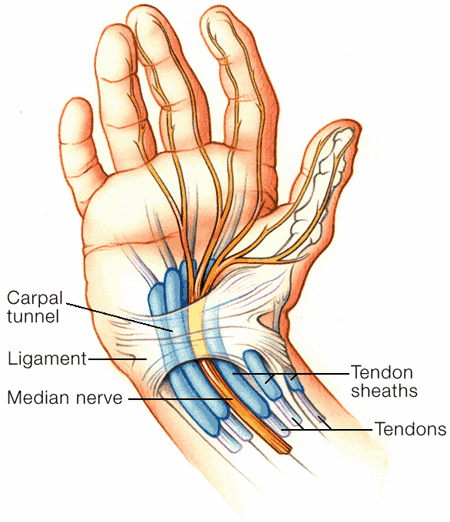
 The median nerve is commonly responsible for these symptoms--but surprisingly, the carpal tunnel is not usually the problem! The median nerve begins in the upper arm near the biceps and has multiple locations it can be irritated, inflamed, and entrapped. The most common location is as it crosses the elbow and weaves dives between multiple muscles that control the forearm and wrist.
Individuals who sit at a desk for multiple hours in a day or work with repeating motions in their hands and arms are particularly at risk for carpal tunnel symptoms. Athletes in tennis, golf, and throwing sports also experience irritation in the carpal tunnel.
For the patient this week, she types for 6 hours/day for work and likes to bowl twice/week. When examined, her symptoms all appeared when testing muscles that control her elbow. After 3 treatments, she no longer has the numbness, tingling, and swelling she had experienced in her hand/wrist.
At home, you can help prevent carpal tunnel irritation--especially if you have a job that requires repetitive motion or long-term holding of your hands at a computer:
I was encouraging this patient that her carpal tunnel symptoms can be caused by more than just tightness at the wrist. The carpal tunnel is located near the wrist:
Individuals who sit at a desk for multiple hours in a day or work with repeating motions in their hands and arms are particularly at risk for carpal tunnel symptoms. Athletes in tennis, golf, and throwing sports also experience irritation in the carpal tunnel.
For the patient this week, she types for 6 hours/day for work and likes to bowl twice/week. When examined, her symptoms all appeared when testing muscles that control her elbow. After 3 treatments, she no longer has the numbness, tingling, and swelling she had experienced in her hand/wrist.
At home, you can help prevent carpal tunnel irritation--especially if you have a job that requires repetitive motion or long-term holding of your hands at a computer:
- take regular breaks--Stand up 3 times/hr, roll your shoulders back and let your arms fall back
- do 3 snow angel movements, keeping your hands open and rolling your thumbs backward
- extend your wrists, elbows, and arms while taking 3 slow deep breaths
- gently move and lightly stretch your palms, wrists, and forearms
Wednesday, March 10, 2010
The more tests I get, the healthier I am. Right?
Interesting commentary about the use/value of medical testing. I really enjoyed the wisdom shared about when and how tests should be used.
http://www.npr.org/templates/story/story.php?storyId=124279916
Joe Wright, M.D. is the author of the commentary; here is his blog-- http://hemodynamics.blogspot.com/
It's important for patients and physicians to think critically and constructively for each test taken. This applies most directly for chiropractic care regarding X-rays. Many chiropractors x-ray a majority and even every patient. This is not supported by research. I feel strongly that x-rays are a valuable tool to be used only when clinically prudent. At Tri-Synergy Chiropractic, we do not suggest an x-ray unless we feel it is in the best interest of the patient's outcomes.
http://www.npr.org/templates/story/story.php?storyId=124279916
Joe Wright, M.D. is the author of the commentary; here is his blog-- http://hemodynamics.blogspot.com/
It's important for patients and physicians to think critically and constructively for each test taken. This applies most directly for chiropractic care regarding X-rays. Many chiropractors x-ray a majority and even every patient. This is not supported by research. I feel strongly that x-rays are a valuable tool to be used only when clinically prudent. At Tri-Synergy Chiropractic, we do not suggest an x-ray unless we feel it is in the best interest of the patient's outcomes.
Wednesday, March 3, 2010
The tarp goes down before the tent! --preparing a strong core
A patient came to the office this week with pain in her right hip. After reviewing her experience--pain during running, pain walking up stairs, and soreness in her thigh--and a full examination, I recommended to her we begin some core rehab beginning with Transverse Abdominis (TA) recruitment.
We will refrain from a long academic tangent about the TA muscle. She felt my analogy was more helpful: one way of thinking of the TA is like the tarp on a camping trip. Just like the tarp, proper core control begins with the TA muscle. Optimally, our TA is like a firm belt--supporting the spine, pelvis, torso, and other abdominal muscles. Our TA is located about the same place a large belt buckle would be, firming and strengthening nearly every motion of the body.
When camping, you start with the tarp, and it will help prevent moisture from ruining a good night's sleep and protect your tent. A tarp is often an afterthought yet regretted when forgotten. Just like the TA--an afterthought until it's a problem.
As you are considering "core workouts" and resolution of back, hip, or knee pain. It is a great idea to investigate whether you are able to engage and utilize the Transverse Abdominis. It may be the answer to your symptoms.

At home test: touch the bony prominences in the front of your pelvis (6" to the side of a belly button and 3" down). Now move to the center 1" and down 1". While lying on your back, and holding 2 fingers at that spot, gently firm the muscle under your fingers. Did you feel it? Many of my patients have a tough time finding this, so do not dispair! It is important to be able to hold that muscle firmly while still able to breathe deeply, letting your belly rise and fall. Many patients bring their "six-pack" muscles into it, and this is not optimal. Continue to contract and relax these muscles in a gentle rhythm. You are now working the TA and helping your brain become more aware of this muscle! If you have difficulty performing this contraction, or draw other muscles into it, it may be a sign of TA dysfunction leading to other symptoms. Consider it as you seek to reach your pain-free goals!
We will refrain from a long academic tangent about the TA muscle. She felt my analogy was more helpful: one way of thinking of the TA is like the tarp on a camping trip. Just like the tarp, proper core control begins with the TA muscle. Optimally, our TA is like a firm belt--supporting the spine, pelvis, torso, and other abdominal muscles. Our TA is located about the same place a large belt buckle would be, firming and strengthening nearly every motion of the body.
When camping, you start with the tarp, and it will help prevent moisture from ruining a good night's sleep and protect your tent. A tarp is often an afterthought yet regretted when forgotten. Just like the TA--an afterthought until it's a problem.
As you are considering "core workouts" and resolution of back, hip, or knee pain. It is a great idea to investigate whether you are able to engage and utilize the Transverse Abdominis. It may be the answer to your symptoms.

At home test: touch the bony prominences in the front of your pelvis (6" to the side of a belly button and 3" down). Now move to the center 1" and down 1". While lying on your back, and holding 2 fingers at that spot, gently firm the muscle under your fingers. Did you feel it? Many of my patients have a tough time finding this, so do not dispair! It is important to be able to hold that muscle firmly while still able to breathe deeply, letting your belly rise and fall. Many patients bring their "six-pack" muscles into it, and this is not optimal. Continue to contract and relax these muscles in a gentle rhythm. You are now working the TA and helping your brain become more aware of this muscle! If you have difficulty performing this contraction, or draw other muscles into it, it may be a sign of TA dysfunction leading to other symptoms. Consider it as you seek to reach your pain-free goals!
Subscribe to:
Posts (Atom)



 Posts
Posts


