Gail was in a bad car accident 8 weeks ago--thank goodness she's alright. She's almost back to normal except for the burning in her fingers on both hands and soreness in her forearms. Fortunately, a friend told her about our office--especially how we expect results within a few visits. I took over 40 minutes listening to her story, and it surprised me how clearly she described the moment of injury. She said that the airbag came out so fast, it ripped her hands from the wheel before she could let go. I pondered what I would ask my students about this case: "which muscle begins in the forearm, crosses the wrist, attaches to the fingers, and would explain burning in the fingers and pain in the forearm?" Any guesses?? ...
Flexor digitorum profundus/superficialis indeed! Sounds like a likely scenario for the symptoms she describes. What does this mean? It means Gail's story matches her continued symptoms, and it's likely something that can be treated and resolved quickly. It means that following a thorough exam (to make sure we're not jumping to conclusions but evaluating the facts), we can gently treat these muscles in the palm side of her forearm and look for quick relief and comfort.
Happier ever after? Yes. But could have been much smoother. Another chiropractor had told her that she had whiplash in her neck and that's what caused her pain. He adjusted her neck for 6 weeks without improvement to her pain. He told Gail she needed to stick with his program, and she would be better in a few months. Disappointing! She asked her primary care MD, and he prescribed her pain killers and told her to return if it didn't get better. I wish he had known about the care we could provide. I'm most glad that Gail is feeling better and able to use her hands without burning or pain.
Showing posts with label carpal tunnel. Show all posts
Wednesday, January 12, 2011
Sunday, March 21, 2010
Carpal Tunnel - One patient's story
Great question from a patient this week: "if it's my wrist and fingers that hurt, how come my elbow is the problem?"
Individuals who sit at a desk for multiple hours in a day or work with repeating motions in their hands and arms are particularly at risk for carpal tunnel symptoms. Athletes in tennis, golf, and throwing sports also experience irritation in the carpal tunnel.
For the patient this week, she types for 6 hours/day for work and likes to bowl twice/week. When examined, her symptoms all appeared when testing muscles that control her elbow. After 3 treatments, she no longer has the numbness, tingling, and swelling she had experienced in her hand/wrist.
At home, you can help prevent carpal tunnel irritation--especially if you have a job that requires repetitive motion or long-term holding of your hands at a computer:
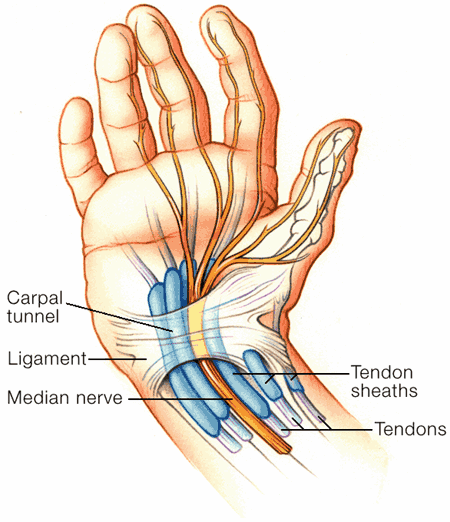
I was encouraging this patient that her carpal tunnel symptoms can be caused by more than just tightness at the wrist. The carpal tunnel is located near the wrist:
The median nerve is commonly responsible for these symptoms--but surprisingly, the carpal tunnel is not usually the problem! The median nerve begins in the upper arm near the biceps and has multiple locations it can be irritated, inflamed, and entrapped. The most common location is as it crosses the elbow and weaves dives between multiple muscles that control the forearm and wrist.Individuals who sit at a desk for multiple hours in a day or work with repeating motions in their hands and arms are particularly at risk for carpal tunnel symptoms. Athletes in tennis, golf, and throwing sports also experience irritation in the carpal tunnel.
For the patient this week, she types for 6 hours/day for work and likes to bowl twice/week. When examined, her symptoms all appeared when testing muscles that control her elbow. After 3 treatments, she no longer has the numbness, tingling, and swelling she had experienced in her hand/wrist.
At home, you can help prevent carpal tunnel irritation--especially if you have a job that requires repetitive motion or long-term holding of your hands at a computer:
- take regular breaks--Stand up 3 times/hr, roll your shoulders back and let your arms fall back
- do 3 snow angel movements, keeping your hands open and rolling your thumbs backward
- extend your wrists, elbows, and arms while taking 3 slow deep breaths
- gently move and lightly stretch your palms, wrists, and forearms
Labels:
carpal tunnel,
median nerve,
soft tissue therapy
Subscribe to:
Posts (Atom)